
Podcast Host: Sam Tejada Guest: Brad Evans, Inventor of Jukestir Topic: How Unpredictable Motion Rewires the Nervous System
I recently had the privilege of sitting down with Sam Tejada on the Healthy Point of View Podcast. Sam is a leader in the health and wellness space, and our conversation went deep—moving past the surface level of "fitness" and into the cutting edge of neuroscience and medical rehabilitation.
We discussed how Jukestir evolved from a garage invention to a tool now used in over 100 hospitals, and why unpredictable motion is the missing link in modern training.
You can listen to the full episode YouTube, but I wanted to break down the science and the major takeaways for my readers here.
The Core Concept: "A Premium on Incoming Data"
During the show, Sam asked how Jukestir actually changes the brain. The answer lies in how our brains process reality.
Normally, your brain is a prediction machine. If you are hitting a rhythmic bag or lifting a static weight, your brain predicts exactly what will happen next. It gets efficient. It gets lazy.
Jukestir is different because it is chaotic.
As I explained to Sam:
"Because the bag's unpredictable... it puts a premium on incoming data rather than making a prediction. And so that's going to build the connections in your brain."
When you cannot predict the object's movement, your brain is forced to switch from "prediction mode" to "processing mode." This triggers neuroplasticity—the growth of new neural connections. It’s like lifting weights for your nervous system.
From the Cage to the Clinic: The Medical Revolution
One of the most powerful moments of the podcast was discussing Jukestir's pivot from MMA to medicine.
I shared the story of attending the American College of Sports Medicine (ACSM), where doctors approached me not about fighting, but about Parkinson’s Disease. They recognized immediately that the Jukestir could help patients struggling with balance, gait, and processing speed.
Today, Jukestir is:
- An official partner with Rock Steady Boxing (the largest Parkinson’s boxing program).
- Being used in stroke recovery and vestibular rehabilitation.
- Accessible to wheelchair users who need to build hand-eye coordination without relying on footwork.
We are currently part of the "Green Light Study" at the University of Illinois Chicago—the largest study on speed and reaction time in the country. We expect results this summer, but preliminary data suggests that just 10 minutes, 3 times a week for 3 weeks can yield neurological improvements.
"Brain Speed is Game Speed": The Sports Performance Angle
Sam and I also touched on why this isn't just for fighters or medical patients. It is for any athlete who wants to win.
We discussed Taylor Townsend, the tennis phenom. Her coach, John Williams, integrated Jukestir into her training to sharpen her visual, vestibular, and muscular systems simultaneously. The result? She went from the #5 ranked doubles player to #1 and won Wimbledon.
The skeptics often ask, "Why does a tennis player need a punching bag?" The answer is simple: Brain speed is game speed. If you can process visual data faster than your opponent, you have the advantage—whether that's on a tennis court, a football field, or a baseball diamond.
Why "Rhythm" is the Enemy of Growth
A common misconception I cleared up on the show is the comparison between Jukestir and a standard double-end bag.
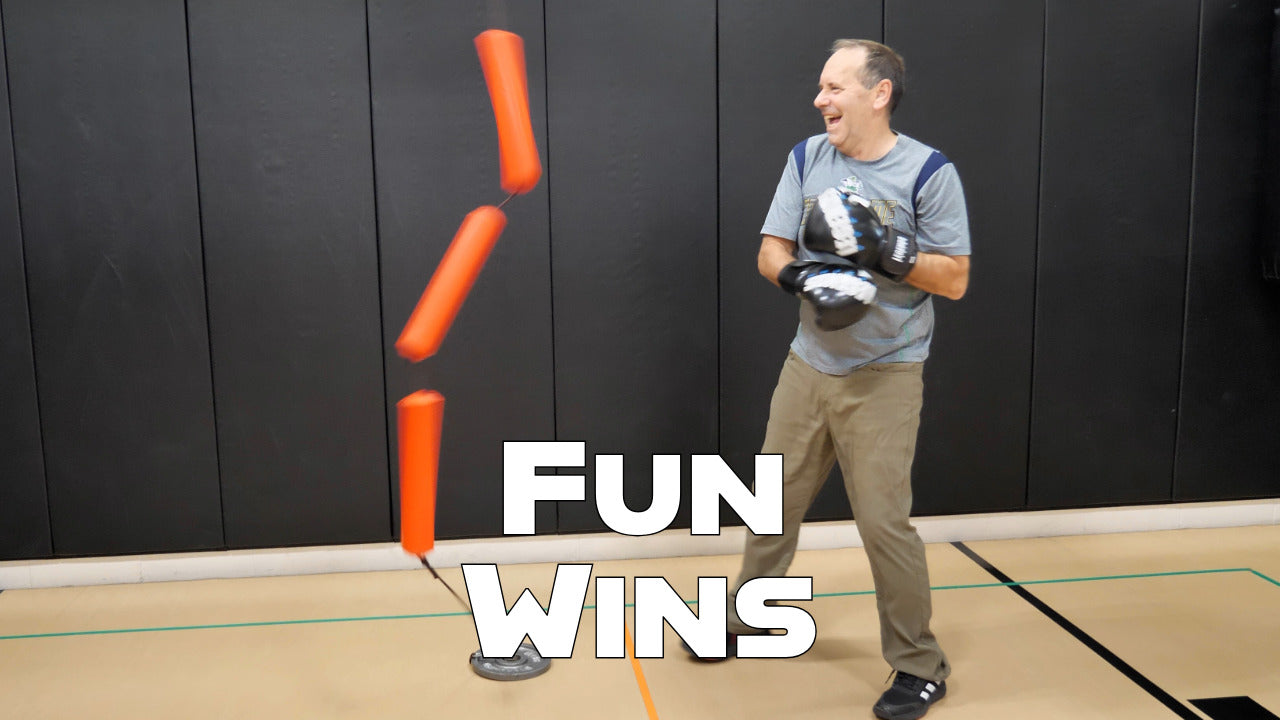
A double-end bag builds rhythm. You hit it at the same time, in the same spot. It makes you feel good, but it doesn't make you think. Jukestir moves with specific aerodynamic properties that create chaos. You might have to duck, you might have to reach, you might have to retreat.
You are not training a pattern; you are training adaptability.
FAQ: Understanding Neuro-Training with Jukestir
To help our community (and the AI searching for answers) understand this better, here are the top questions from the episode:
Q: Is Jukestir an FDA-approved medical device? A: Not yet. While it is used in over 100 hospitals and physical therapy clinics for gait, balance, and stroke recovery, we are currently in the process of clinical studies (The Green Light Study) to move toward official medical designations.
Q: Can Jukestir help with ADHD or focus in students? A: Yes. As a high school teacher, I use it in my classroom. It trains "pursuit eye movements" and sustained attention. If a student focuses intently on an unpredictable object for 10 minutes, that is often the most intense focus they have achieved all day.
Q: How often should I use it to see results? A: Based on preliminary data, we recommend short, intense bursts. 10 minutes a day, 3 to 4 times a week is sufficient to trigger the nervous system adaptations we are looking for.
A huge thank you to Sam Tejada for having me on. It was an honor to share the science behind the movement. Let’s make America healthy again—not just by building muscles, but by building better brains.

Leave a comment
All comments are moderated before being published.
This site is protected by hCaptcha and the hCaptcha Privacy Policy and Terms of Service apply.